
Air quality and temperature control are important for factories, warehouses, production units, and commercial buildings. In large spaces, maintaining a comfortable indoor environment can be challenging, especially during hot weather. An air washer system is a useful solution that helps cool, clean, and humidify air according to the requirements of a building or industrial process.
Air washer systems are widely used in industrial ventilation and HVAC applications because they treat incoming air with the help of water. They can help reduce airborne dust, control humidity, and improve indoor comfort when properly designed and maintained.
In this blog, we will explain the working principles of air washer systems, their main features, key benefits, common applications, and factors to consider before choosing a suitable unit.
What Is an Air Washer System?
An air washer system is an air treatment unit that uses water sprays or wetted surfaces to clean and condition air. Depending on its design, it can perform functions such as cooling, humidification, and the removal of certain airborne particles.
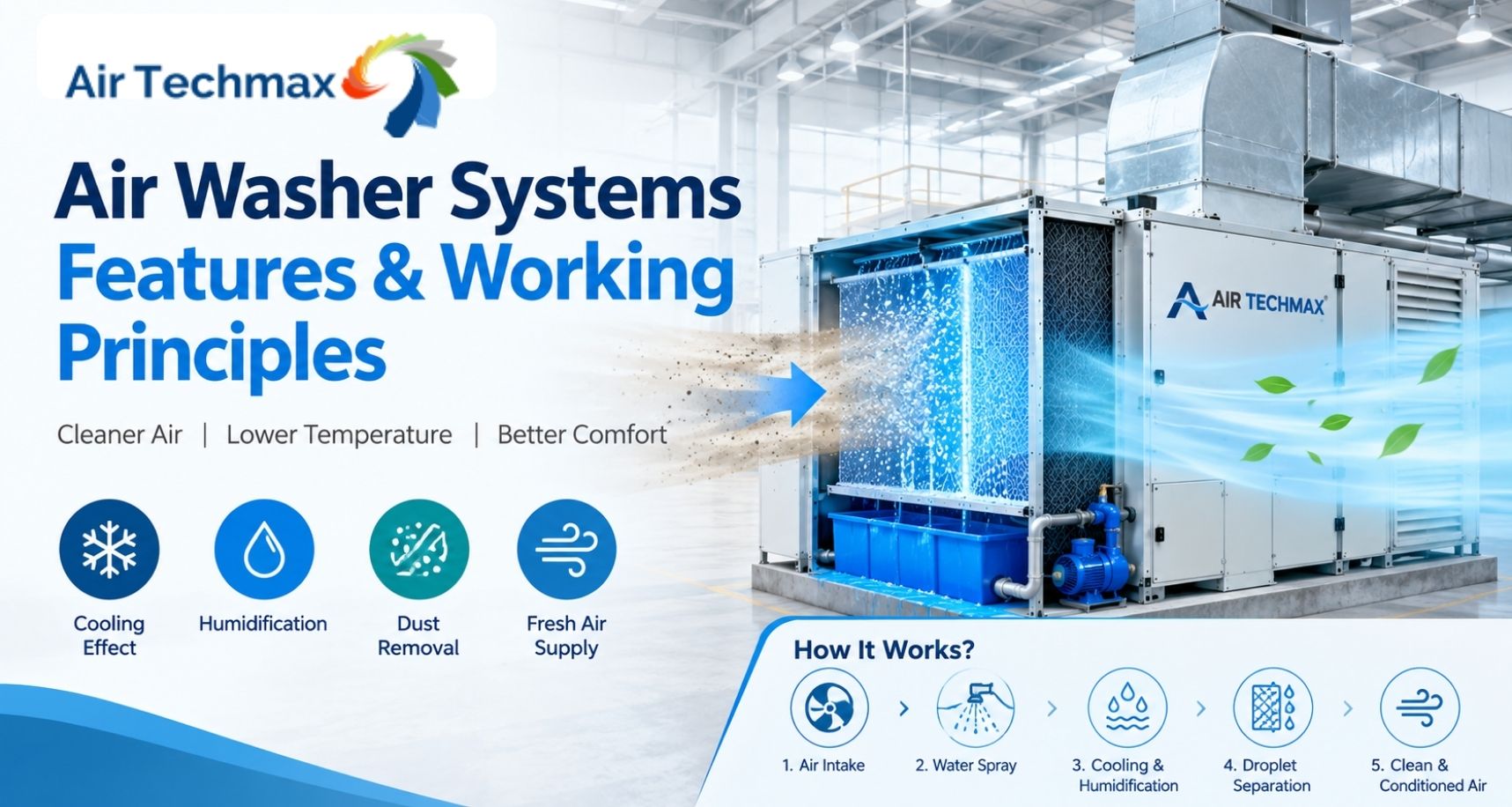
The system generally includes a fan or blower, water tank, circulation pump, spray nozzles, filters, and a water droplet separator. These components work together to treat incoming air before supplying it to the required area.
An industrial air washer is especially useful in environments where temperature, humidity, ventilation, and air cleanliness need to be managed together. It can also be integrated into a larger HVAC system to meet specific indoor air requirements.
How Does an Air Washer System Work?
The working principle of an air washer system is based on direct contact between air and water. When warm air comes into contact with water droplets or wet surfaces, heat can transfer from the air to the water. Some of the water evaporates, reducing the air temperature while increasing its moisture content.
Here is how the process usually works.
- Air Intake
The system draws outside air into the unit through an air inlet. Depending on the installation, pre-filters or other filtration arrangements may be used to capture larger dust particles before the air enters the washing section.
- Water Spraying
A circulation pump moves water from the tank to spray nozzles. These nozzles distribute water into the air stream, creating contact between the incoming air and water droplets.
- Air Cooling and Humidification
As the air passes through the water spray section, some heat is transferred to the water. When evaporation occurs, the air temperature can decrease. At the same time, moisture is added to the air.
The cooling effect depends on outdoor temperature, relative humidity, water temperature, airflow, and the system design. Evaporative cooling generally performs better in hot, dry conditions than in hot, humid weather.
- Removal of Certain Dust Particles
Water droplets can capture some airborne dust and other particles that come into contact with them. The effectiveness depends on particle size, water contact, air velocity, and equipment design.
An air washer should not be considered a complete solution for every airborne contaminant. Fine particles, hazardous fumes, and specific industrial pollutants may require dedicated filters or other air-cleaning equipment.
- Droplet Separation
Before the treated air leaves the unit, a droplet eliminator helps prevent water droplets from travelling with the airflow. This is an important feature for protecting downstream ducts and equipment from unwanted moisture.
- Air Supply and Distribution
A fan or blower moves the treated air into the required space through ducts or supply outlets. The system can provide conditioned air to selected areas of a factory, warehouse, workshop, or commercial building.
Water that has not evaporated is usually collected in the tank and recirculated. The system also needs suitable water-level control, cleaning, and water replacement to maintain reliable operation.
Key Features of Air Washer Systems
Modern air washer systems can offer several features that support industrial and commercial air treatment. The exact features depend on the unit design and project requirements.
- Efficient Air Cooling
Air washers can reduce incoming air temperature through evaporative cooling or, in suitable designs, chilled-water operation. This makes them useful for many large industrial spaces where practical cooling is required.
- Air Washing and Dust Control
The water spray section helps remove certain particles from the air. When combined with suitable pre-filters, an air washer can support better air cleanliness in manufacturing and commercial environments.
- Humidity Control
Air washer systems can add moisture to dry incoming air. This can be useful in industries where stable humidity is important for materials, equipment, or production processes.
For applications requiring precise humidity control, the system should be selected and configured according to the required temperature and relative humidity levels.
- Continuous Fresh-Air Supply
An air washer can be designed to treat outdoor air and supply it to an indoor space. A properly planned ventilation system also provides a route for indoor air to leave the building, helping prevent unwanted heat and pollutants from building up.
- Water Recirculation
Many air washer systems collect unused spray water and pump it back through the system. This reduces the need to supply fresh water continuously, although evaporation, blowdown, leakage, and maintenance still affect overall water consumption.
- Integration with HVAC Systems
Air washers can be installed as part of an HVAC or air-handling arrangement. Depending on the application, they may work with filters, ducting, exhaust systems, temperature controls, and humidity sensors.
- Flexible Design Options
Industrial air washers are available in different capacities and configurations. Factors such as airflow, cooling requirements, installation space, water quality, and operating conditions help determine the appropriate design.
- Practical Maintenance
A well-designed system allows access to the tank, pump, nozzles, filters, and droplet eliminators for inspection and cleaning. Regular maintenance helps reduce the risk of blockages, scale formation, corrosion, and poor water quality.
Benefits of Using an Air Washer System
Choosing the right air washer system can provide several advantages for suitable industrial and commercial applications.
- Improved indoor comfort: Helps manage air temperature and humidity according to operating conditions.
- Better air cleanliness: Water contact can remove some airborne dust and particles.
- Energy-conscious cooling: Evaporative systems can use less electricity for cooling than conventional refrigeration-based systems in suitable conditions.
- Support for industrial processes: Helps maintain environmental conditions required by selected manufacturing operations.
- Fresh-air ventilation: Can be designed to provide a continuous supply of treated outdoor air.
- Scalable applications: Different capacities and configurations can serve small commercial areas or larger industrial facilities.
- Combined air treatment: Certain systems provide cooling, humidification, and particle removal within one arrangement.
Actual energy savings and performance depend on climate, system sizing, water consumption, ventilation design, and the alternative cooling system.
Common Applications of Air Washer Systems
Air washer systems are used in different industries and commercial environments where air treatment is an important requirement.
Manufacturing Plants and Factories
Factories can use air washers to help control heat, humidity, and airborne dust in suitable production areas. The system should be designed around the heat generated by machinery and the ventilation needs of the process.
Textile Industries
Textile manufacturing may require humidity control to support yarn handling and production quality. An appropriately designed air washer can help maintain the required moisture levels.
Warehouses and Storage Facilities
Large warehouses may use air washers to provide ventilation and cooling in suitable climates. The final design should account for the stored materials, occupancy, humidity requirements, and outdoor conditions.
Commercial Buildings
Restaurants, workshops, halls, and other commercial spaces may benefit from air treatment where fresh-air supply and practical cooling are important.
Printing and Paper Industries
Some printing and paper processes require controlled humidity to reduce problems associated with excessively dry air. An air washer can be considered when its operating range matches the process requirements.
Industrial HVAC Applications
Air washers can form part of a larger HVAC system where cooling, air washing, and humidification are required. Applications involving chemical fumes, hazardous dust, or strict hygiene requirements need additional assessment and suitable treatment equipment.
Air Washer System vs. Conventional Air Conditioning
Both air washers and conventional air conditioners can help manage indoor temperatures, but they work differently.
| Feature | Air Washer System | Conventional Air Conditioner |
| Main working principle | Water-based air treatment or evaporative cooling | Refrigeration cycle |
| Humidity effect | Often adds moisture in evaporative operation | Usually removes moisture during cooling |
| Outdoor air | Can be designed for high outdoor-air supply | Depends on the system and ventilation design |
| Performance in humid weather | Evaporative cooling is generally less effective | Refrigeration-based cooling can provide more consistent cooling |
| Energy use | Can be lower for suitable evaporative applications | Depends on equipment efficiency and operating conditions |
| Best suited for | Selected industrial and commercial ventilation and cooling needs | Applications requiring controlled cooling and, where designed, dehumidification |
An air washer is not always a replacement for an air conditioner. The right option depends on the local climate, indoor temperature target, humidity requirements, ventilation needs, and operating budget.
Factors to Consider Before Choosing an Air Washer System
Before purchasing an air washer, businesses should evaluate the following points.
- Required airflow: Calculate the air volume needed for the size and use of the space.
- Cooling requirements: Consider outdoor conditions, indoor heat loads, machinery, and the target indoor temperature.
- Humidity levels: Check whether the application requires additional moisture or tighter humidity control.
- Water quality: Hard water and impurities can cause scaling or blockages. Suitable water treatment and cleaning arrangements may be needed.
- Filtration requirements: Select filters and other air-cleaning stages according to the type and size of particles that need to be controlled.
- Installation space: Check the available space for the unit, water tank, ducts, piping, and maintenance access.
- Operating and maintenance costs: Consider electricity, water consumption, filter replacement, cleaning, and servicing.
- Supplier support: Choose a supplier that can help assess the application, select suitable equipment, and provide installation or after-sales support where required.
A professional assessment can help ensure that the system is correctly sized and suited to the actual working conditions.
Why Choose Air Techmax for Air Washer Solutions?
Air Techmax provides air cooling solutions for industrial, commercial, and other applications. The company offers air washer solutions intended to support air cooling, humidification, and air treatment requirements.
When selecting an air washer, it is important to understand the space, required airflow, outdoor climate, and operating conditions before finalising the equipment. Air Techmax can be a starting point for businesses exploring suitable air cooling options for their facilities.
Conclusion
Air washer systems are useful for industrial and commercial environments that need practical air treatment, ventilation, cooling, or humidity control. By bringing air into contact with water, these systems can support evaporative cooling and help remove certain airborne particles.
Understanding the features and working principles of an air washer makes it easier to compare equipment and select a solution that fits the actual application. Before making a decision, evaluate the local climate, airflow, humidity requirements, water quality, and maintenance needs.
Frequently Asked Questions (FAQs)
- What is the main purpose of an air washer system?
The main purpose of an air washer system is to treat air using water. Depending on its design, it can help cool air, add moisture, and remove certain airborne particles.
- What is the working principle of an air washer?
An air washer works by bringing moving air into contact with water droplets or wet surfaces. Heat transfer and evaporation can cool the air, while the water can capture some particles. The exact result depends on the water temperature and system configuration.
- Are air washer systems energy-efficient?
Air washer systems using evaporative cooling can be energy-efficient in suitable climates because they do not need a conventional refrigeration cycle for that cooling process. Actual energy use depends on the fan, pump, operating conditions, and system design.
- Where are industrial air washer systems used?
They are used in selected factories, textile mills, warehouses, printing facilities, workshops, and commercial buildings where ventilation, cooling, air washing, or humidity control is required.
- Do air washers work well in humid weather?
Evaporative cooling becomes less effective when outdoor humidity is high because the air has less capacity to absorb additional moisture. Chilled-water configurations may behave differently, so the system should be selected according to the required performance.
- How often should an air washer system be maintained?
Maintenance frequency depends on water quality, operating hours, dust levels, and the manufacturer’s instructions. Regular checks of the tank, pump, nozzles, filters, and droplet eliminators are important.
- How can I choose the right air washer for my factory?
Consider the factory size, required airflow, heat load, outdoor humidity, target temperature, water quality, and filtration needs. A professional assessment can help determine the correct capacity and configuration.