
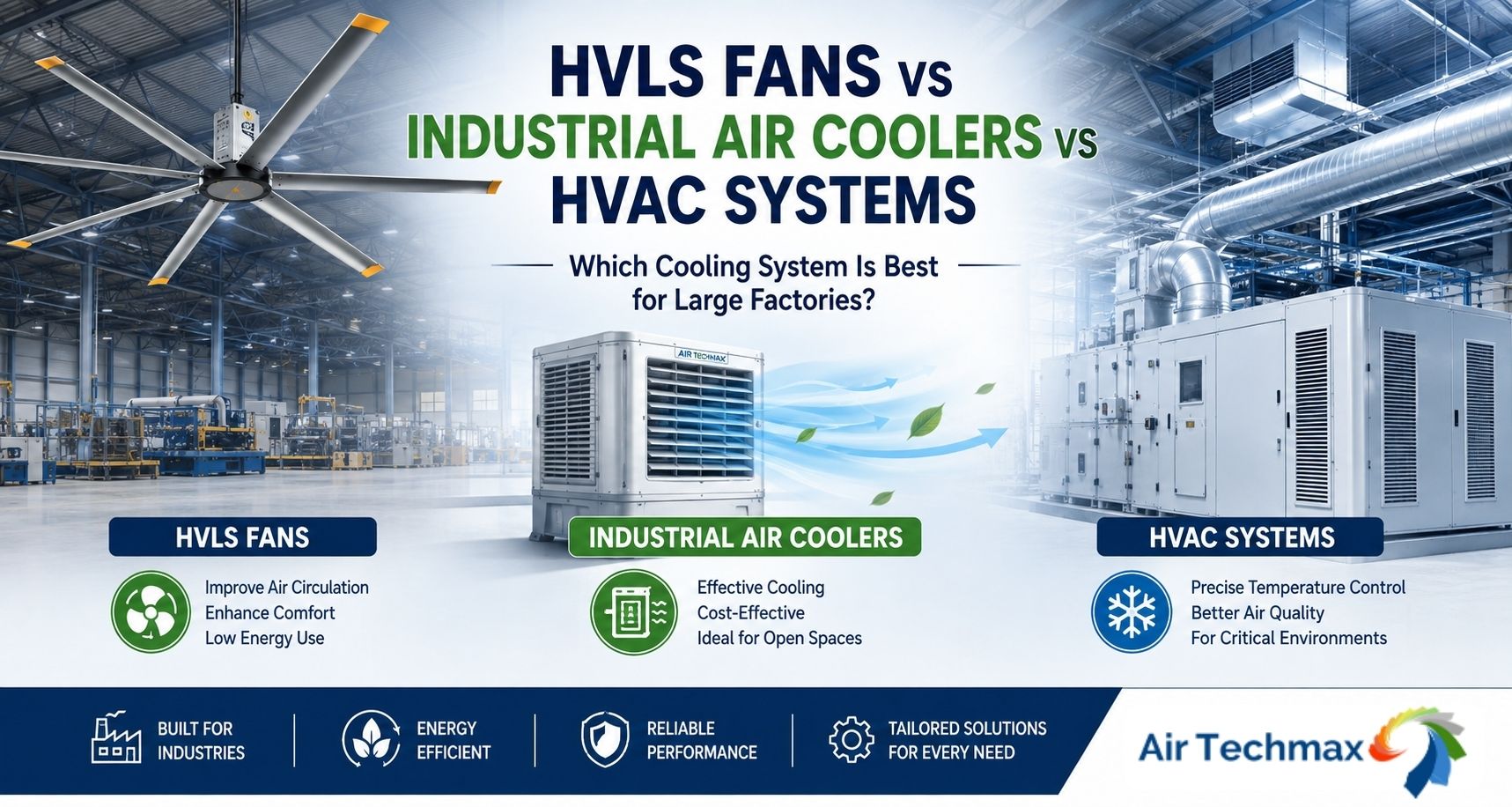
Large factories face a different cooling challenge compared to homes or small offices. A factory may have high ceilings, large floor areas, heat-producing machinery, multiple workers, dust, humidity, and continuously changing operating conditions.
Because of this, choosing the right cooling solution is not simply about buying the biggest machine. Factory owners need to understand whether HVLS Fans, Industrial Air Coolers, or an HVAC system will actually suit their space and operational requirements.
Each solution works differently. An HVLS fan mainly improves air movement, an industrial air cooler uses evaporative cooling to supply cooler air, and an HVAC system can provide controlled temperature, humidity, ventilation, and filtration depending on the design. Industrial cooling requirements can also vary based on the manufacturing process, worker comfort needs, air quality requirements, and internal heat load.
In this blog, we compare all three options to help you choose the right cooling system for your factory.
Quick Comparison: HVLS Fans vs Industrial Air Coolers vs HVAC
| Feature | HVLS Fans | Industrial Air Coolers | HVAC Systems |
| Main function | Improves air circulation | Supplies cooled air through evaporation | Provides controlled cooling and ventilation |
| Best for | Large open spaces | Factories and well-ventilated industrial areas | Controlled industrial and commercial environments |
| Temperature reduction | Creates a cooling effect through airflow | Can reduce supply-air temperature depending on ambient conditions | Provides mechanical temperature control |
| Energy requirement | Generally low | Moderate and application-dependent | Usually higher than fans or evaporative systems |
| Humidity control | No direct control | Adds moisture to the air | Can control humidity depending on system design |
| Installation | Ceiling-mounted | Portable, fixed or ducted options | Requires professional system design and installation |
| Suitable for large spaces | Yes | Yes | Yes, when properly designed |
| Best use case | Air circulation and worker comfort | Cost-conscious cooling in suitable climates | Precise temperature and environmental control |
The right choice depends on your factory conditions. In many cases, the best solution may even be a combination of two technologies rather than a single system.
1. Understanding HVLS Fans for Large Factories
HVLS Fans Manufacturers design High Volume, Low Speed fans for large industrial and commercial spaces. These fans have large diameters and operate at relatively low speeds while moving a high volume of air.
Instead of directly lowering the air temperature like an air conditioner, an HVLS fan improves air movement across a large area. This airflow can make workers feel more comfortable and help reduce stagnant air in large spaces.
HVLS fans are commonly used in:
- Manufacturing plants
- Warehouses
- Logistics centres
- Assembly areas
- Workshops
- Agricultural facilities
- Large commercial buildings
Air Techmax offers HVLS fan solutions designed for large facilities where conventional small fans may not provide effective coverage.
Key Benefits of HVLS Fans
Large Area Coverage
One properly selected HVLS fan can circulate air across a significant floor area. This makes the technology suitable for factories with wide open spaces and high ceilings.
Improved Worker Comfort
Air movement creates a cooling sensation on the skin, which can improve comfort in hot working environments.
Better Air Circulation
Factories can develop hot and stagnant zones, especially in areas with limited airflow. HVLS fans help improve overall air circulation.
Lower Energy Use Compared With Full Air Conditioning
Because HVLS fans are designed primarily for air movement rather than mechanical refrigeration, they can be a practical option where complete temperature control is not required.
Limitations of HVLS Fans
HVLS fans should not be treated as a replacement for air conditioning in every situation.
They do not directly cool the air through refrigeration or evaporation. Therefore, if your factory requires a specific indoor temperature, humidity level, or controlled environment, a fan alone may not be sufficient.
HVLS Fans Are Best For:
- Large open factories
- Warehouses
- High-ceiling buildings
- Worker comfort improvement
- Facilities requiring better air circulation
- Businesses looking to improve airflow without installing a complete HVAC system
2. Understanding Industrial Air Coolers
Industrial Air Cooler Manufacturers provide high-capacity cooling systems designed for factories, warehouses, workshops, and other large spaces.
Most industrial air coolers use the principle of evaporative cooling. Warm air passes through wet cooling media, and evaporation helps lower the air temperature before the air is supplied into the working area.
Evaporative cooling is commonly used in industrial applications, particularly where full mechanical refrigeration may not be necessary or economically suitable. Its performance, however, depends on outdoor conditions, humidity, airflow design, and the specific application.
Benefits of Industrial Air Coolers
Actual Air Cooling
Unlike a fan that mainly improves air movement, an industrial air cooler can supply cooler air into the factory.
Suitable for Large Industrial Areas
Industrial air coolers are available in portable, fixed, ducted, and centralized configurations. This allows systems to be selected based on the size and layout of the facility.
Cost-Effective Alternative for Suitable Applications
For factories where precise temperature and humidity control are not required, evaporative cooling can be a practical option.
Flexible Installation Options
Depending on the facility, industrial coolers can be:
- Ducted
- Wall-mounted
- Roof-mounted
- Centrally installed
- Portable for specific work areas
Air Techmax already offers different industrial cooling configurations, including ducted, heavy-duty, portable and centralized solutions for large-scale facilities.
Limitations of Industrial Air Coolers
Evaporative cooling performance is influenced by the climate and humidity level. Since the process adds moisture to the air, it may not be the ideal solution for every factory or manufacturing process.
Proper ventilation and exhaust planning are also important. A cooler should not simply be installed without considering airflow movement, building openings, and heat sources.
Industrial Air Coolers Are Best For:
- Manufacturing units
- Workshops
- Warehouses
- Textile and fabrication facilities
- Large open industrial areas
- Facilities where evaporative cooling is suitable
- Businesses looking for cooling without the complexity of full HVAC
3. Understanding HVAC Systems for Factories
HVAC Air Conditioning System Manufacturers design systems that can manage more than just cooling. Depending on the system, HVAC can address:
- Temperature
- Ventilation
- Humidity
- Air filtration
- Air distribution
- Indoor air quality
For industrial facilities, HVAC requirements can be linked not only to worker comfort but also to the manufacturing process itself. Some operations may require specific environmental conditions to support product quality, equipment performance, cleanliness, or safety.
Benefits of HVAC Systems
Precise Temperature Control
HVAC systems can maintain more controlled indoor conditions compared with fans or standard evaporative coolers.
Better Suitability for Sensitive Processes
Industries such as pharmaceuticals, food processing, electronics, laboratories, and other controlled environments may require carefully designed temperature, humidity, and filtration systems.
Integrated Ventilation
A properly designed HVAC system can distribute conditioned air throughout different zones of a facility.
Air Filtration and Quality Management
Depending on the system design, filters and ventilation components can help manage dust and airborne contaminants.
Air Techmax provides HVAC solutions designed for industrial and commercial cooling requirements.
Limitations of HVAC Systems
HVAC systems generally require:
- Higher initial investment
- Professional load calculation and system design
- Ducting or other distribution infrastructure
- Regular maintenance
- Greater energy planning
For a large open factory where only worker comfort is required, installing a full HVAC system may not always be the most practical solution.
HVAC Systems Are Best For:
- Temperature-sensitive manufacturing
- Pharmaceutical facilities
- Food processing units
- Electronics manufacturing
- Laboratories
- Clean or controlled environments
- Commercial facilities requiring consistent indoor conditions
HVLS Fans vs Industrial Air Coolers: Which Is Better?
The answer depends on what you expect from the system.
Choose HVLS Fans when your main requirement is:
- Better air circulation
- Improved worker comfort
- Air movement across a large area
- Coverage for a high-ceiling facility
Choose Industrial Air Coolers when your main requirement is:
- Cooler supply air
- Cooling for a large industrial area
- A solution suitable for an open or well-ventilated facility
- A practical alternative to full mechanical air conditioning
A factory with extremely high temperatures may benefit more from an industrial air cooling system than from fans alone. However, HVLS fans can still be useful alongside other cooling technologies to improve air distribution.
Industrial Air Coolers vs HVAC: Which Should You Choose?
This comparison mainly depends on the level of environmental control required.
Choose Industrial Air Coolers When:
- Precise temperature control is not necessary
- The building has suitable ventilation
- The application is appropriate for evaporative cooling
- You need cooling for a large open area
- You want a comparatively simpler cooling solution
Choose HVAC When:
- Specific temperature conditions are required
- Humidity needs to be controlled
- The manufacturing process is sensitive to environmental changes
- Air filtration is important
- Different areas require controlled cooling
For industrial facilities, ASHRAE notes that cooling system selection should consider process requirements, temperature, humidity, air movement, air quality, and worker comfort.
HVLS Fans vs HVAC: Which Is More Suitable for a Factory?
These two systems perform very different functions.
An HVLS fan is mainly designed to move air efficiently across a large space. HVAC is designed to condition and manage the indoor environment.
If your factory only feels hot and uncomfortable because of poor air movement, installing HVAC throughout the entire facility may be unnecessary.
However, if the factory requires a controlled temperature for production, storage, equipment, or product quality, HVAC may be the better choice.
In some large facilities, HVLS fans can also be used as part of an overall ventilation and comfort strategy.
Which Cooling System Is Best for Different Types of Factories?
Manufacturing and Assembly Plants
Recommended option: Industrial air coolers, HVLS fans, or a combination of both.
The right choice depends on internal heat, ventilation, ceiling height, and worker density.
Warehouses and Logistics Centres
Recommended option: HVLS fans.
Warehouses often have large open floor areas and high ceilings, making large-scale air circulation especially useful.
Textile and Garment Factories
Recommended option: Industrial air coolers or a designed HVAC system.
The selection should consider worker comfort, moisture requirements, dust, and process conditions.
Food Processing Facilities
Recommended option: HVAC.
Temperature, hygiene, humidity, and air quality requirements may make controlled systems more suitable.
Pharmaceutical and Electronics Manufacturing
Recommended option: HVAC.
These industries may require controlled environmental conditions, including temperature, humidity, filtration, or cleanliness.
Heavy Engineering and Fabrication Units
Recommended option: Industrial air coolers combined with HVLS fans.
These facilities often have large open spaces and significant internal heat. A combination approach can help provide cooling and improve air movement where appropriate.
Can You Combine HVLS Fans, Industrial Air Coolers and HVAC?
Yes. In many large factories, the best answer is not necessarily choosing only one system.
A hybrid approach may be more practical.
For example:
- HVLS fans can improve air circulation.
- Industrial air coolers can supply cooler air to the working zone.
- HVAC systems can be used in enclosed or temperature-sensitive areas.
A factory may have a large production floor that uses industrial coolers and HVLS fans, while offices, laboratories, control rooms, or sensitive production areas use HVAC.
This approach allows the cooling strategy to match the actual requirement of each zone instead of applying the same technology everywhere.
7 Important Factors to Consider Before Choosing a Cooling System
Before contacting HVLS Fans Manufacturers, Industrial Air Cooler Manufacturers, or HVAC Air Conditioning System Manufacturers, evaluate these factors.
1. Factory Size and Ceiling Height
A 5,000 sq. ft. workshop and a 100,000 sq. ft. manufacturing facility require completely different cooling strategies.
Ceiling height is particularly important for HVLS fan selection and air distribution planning.
2. Internal Heat Load
Machines, furnaces, equipment, lighting, and production processes can generate significant heat.
The cooling system should be selected based on the total heat load rather than only the building size.
3. Local Climate and Humidity
Evaporative cooling performance depends on outdoor air conditions. High humidity can affect the amount of cooling achievable.
4. Ventilation Requirements
Fresh-air requirements, exhaust systems, dust, fumes, and other pollutants should be considered before selecting a cooling system.
5. Required Temperature Control
Ask a simple question:
Do you need workers to feel more comfortable, or do you need the factory to maintain a specific temperature?
The answer can significantly change the system selection.
6. Energy and Operating Costs
The lowest purchase price is not always the lowest long-term cost.
Consider:
- Electricity consumption
- Water consumption
- Maintenance
- Replacement parts
- Installation
- System life
- Operational requirements
7. Future Expansion
If production capacity may increase, choose a system that can be expanded or modified without completely replacing the existing installation.
So, Which Cooling System Is Best for Large Factories?
There is no single answer for every factory.
Choose HVLS Fans if:
You need large-scale air movement, improved circulation, and better worker comfort in an open facility.
Choose Industrial Air Coolers if:
You need cooler supply air for a large industrial area and your building and climate conditions are suitable for evaporative cooling.
Choose HVAC Systems if:
You require controlled temperature, humidity, ventilation, or air quality for workers, products, equipment, or manufacturing processes.
Consider a Hybrid Solution if:
Your facility has multiple zones with different cooling requirements.
For example, an open production area may need industrial air coolers and HVLS fans, while enclosed offices and sensitive areas may require HVAC.
Why Choose Air Techmax for Industrial Cooling Solutions?
Choosing the right equipment is important, but correct system selection and planning are equally important.
Air Techmax provides solutions across multiple industrial cooling and airflow categories, including HVLS fans, industrial cooling systems, and HVAC solutions for large industrial and commercial facilities. The company’s existing product range includes solutions for factories, warehouses, and other large-scale applications.
Before selecting a system, the following factors should be evaluated:
- Factory area
- Ceiling height
- Number of workers
- Machinery heat
- Outdoor temperature
- Humidity
- Existing ventilation
- Required cooling level
- Process requirements
- Budget and operating costs
A properly selected solution can provide better performance than simply installing the largest or most expensive cooling system.
Looking for the Right Cooling Solution for Your Factory?
Whether you are searching for reliable HVLS Fans Manufacturers, Industrial Air Cooler Manufacturers, or HVAC Air Conditioning System Manufacturers, Air Techmax can help you identify a solution based on your facility’s specific requirements.
From large open factories and warehouses to commercial and controlled industrial environments, the right cooling strategy starts with understanding your space and operational needs.
Contact Air Techmax to discuss your factory cooling and ventilation requirements and find the right solution for your facility.
Frequently Asked Questions
- Are HVLS fans enough to cool a large factory?
HVLS fans mainly improve air circulation and create a cooling effect through air movement. They can be effective for worker comfort in large open spaces, but they do not directly provide mechanical temperature control.
- Are industrial air coolers better than air conditioners for factories?
Not always. Industrial air coolers can be suitable for large, well-ventilated facilities and applications where evaporative cooling is appropriate. HVAC is generally more suitable when precise temperature or humidity control is required.
- Can HVLS fans and industrial air coolers be used together?
Yes. Industrial air coolers can provide cooler air while HVLS fans can help improve air movement and distribution across a large area. The system should be properly designed to avoid inefficient airflow patterns.
- Which cooling system uses the least energy?
The answer depends on the equipment size, operating hours, facility conditions, and cooling requirement. Fans generally use less energy because they primarily move air, while HVAC systems provide mechanical cooling and environmental control.
- Which cooling system is best for a warehouse?
HVLS fans are often suitable for improving air circulation in large warehouses. However, if actual air cooling is required, industrial air coolers or other systems may also be considered depending on the building and climate conditions.
- What should I check before installing a factory cooling system?
Check the factory area, ceiling height, heat generated by machinery, number of workers, ventilation, local climate, humidity, and whether your production process requires controlled temperature or air quality.